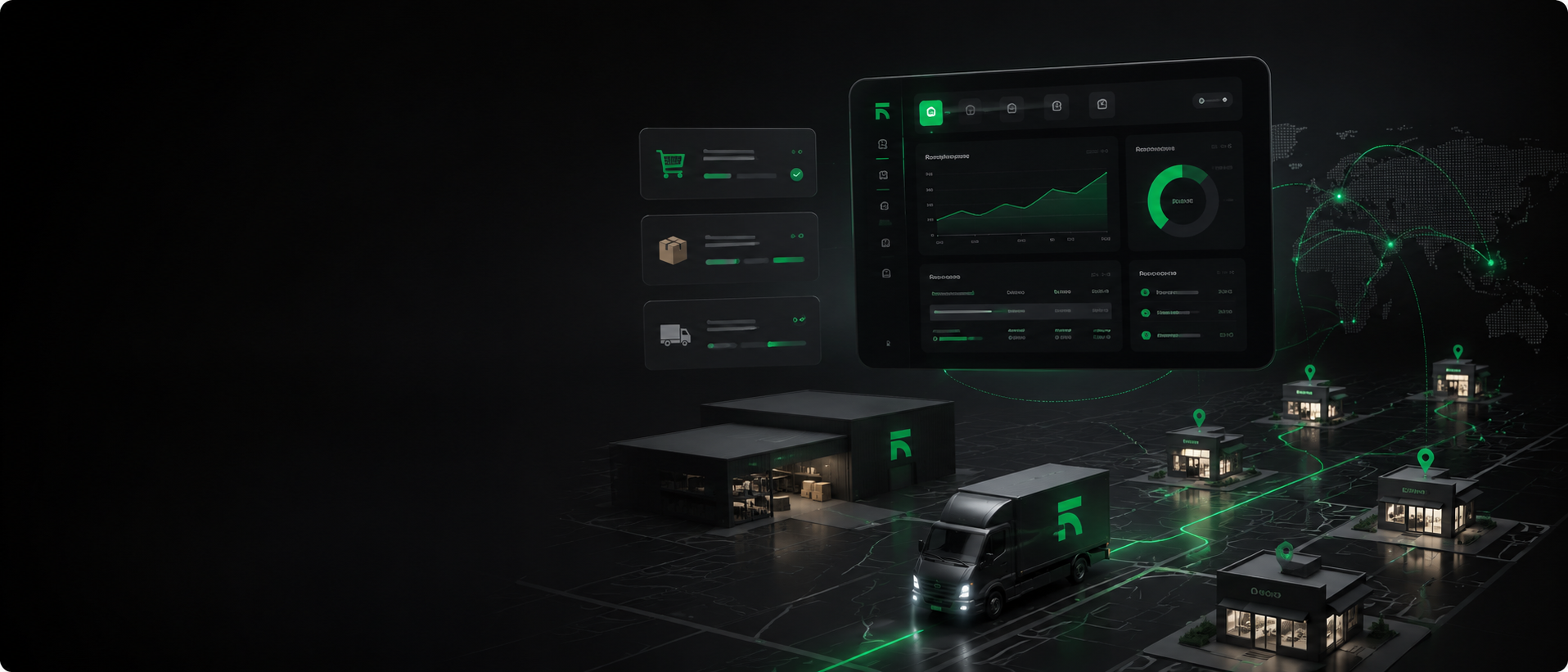
A complete B2B sales and delivery platform for large retailers — flexible enough to match how your organization actually operates, not how a template assumes it does. Every product type. Every pricing policy. Every delivery workflow.
Large retail operations deal with complexity that off-the-shelf order management software wasn't designed for: products sold by unit, by weight, or by volume — sometimes within the same order. Bundles. Tiered pricing. Multiple branches placing orders from a single supplier. Drivers who need their own interface. Customers who need live delivery status. Logistics providers who need coordination between pickup and final-mile.
B2B handles all of it — in a single platform, built around your organization's actual policies rather than a fixed workflow you're forced to adapt to. If you run a different process per branch, B2B supports it. If your discount structure varies by customer tier or order volume, B2B supports that too.
Every stage is tracked: customer order → production → logistics dispatch → branch delivery → invoice confirmation → reporting. Nothing falls through the gaps between your sales team, warehouse, and delivery fleet.
From placing the order to confirming delivery — with reports at every stage for every stakeholder.
Every order from every branch — tracked from placement through production, dispatch, and delivery. The order-to-delivery report shows requested items, sent items, and actually delivered items side by side, so gaps between what was ordered and what arrived are immediately visible.
The production report connects what was ordered with what was produced — per day, per production facility, over any date range. Daily totals, returns, and discrepancies between ordered volume and production output are tracked together so production planning and order management are always aligned.
Every invoice is assigned to a logistics operator and tracked through to delivery confirmation. The delivery management interface shows the driver, customer, branch, delivery timestamp, and invoice status — with the ability to export bulk delivery documents and download consolidated logistics reports per operator or date range.
Most order platforms force you to fit their process. B2B is configured around how your business actually runs — your product types, your pricing policies, your delivery structure.
Products sold by unit count, by weight (kg/g), or by volume (litre/ml) are all handled natively — including bundles that combine different unit types in a single order line. No workarounds, no manual conversion.
Customer-tier pricing, volume discounts, branch-specific rates, and promotional bundles are all configurable per customer or per product category. The platform enforces whatever pricing structure you've defined — consistently, across every order.
Every branch places its own orders independently. The central operations team sees a consolidated view across all branches — with branch-level filtering, comparison, and reporting without needing to aggregate data manually from separate systems.
Drivers access a separate web application optimized for mobile use. They see their assigned deliveries, confirm receipt at each branch, and log any discrepancy between what was loaded and what was delivered — without needing access to the main operations interface.
Customers have their own web app to track orders and confirm delivery. They see order status in real time, receive notifications at key milestones, and can report delivery issues directly through the interface — reducing inbound calls to the operations team.
Order reports, production reports, sales reports, logistics reports — all filterable by date, branch, brand, logistics operator, and production facility. Every report is exportable, and bulk document generation (invoices, delivery notes, logistics manifests) is built in.
B2B is designed for businesses where a spreadsheet-based order process stopped working long ago.
Supplying multiple branch locations daily, with production-to-delivery tracking, branch-level order management, and driver coordination for fresh product delivery windows.
Managing bulk orders from retail customers across multiple locations, with pricing tiers per customer and consolidated logistics coordination across delivery routes.
Central procurement supplying all branches — with each branch ordering independently, management seeing the consolidated picture, and finance getting clean invoicing per location.
If you supply businesses rather than end consumers, and your orders involve more complexity than a standard e-commerce platform handles, B2B is built for your use case.
Things we're asked before most B2B implementations.
Ask DirectlyThe best way to see whether B2B fits your operation is to walk through a demo built around your actual product types, branch structure, and delivery workflow — not a generic retail scenario.